South Africa is one of the world’s great self-drive countries. The main roads are good, the distances between the highlights are manageable, the scenery is constant, and a rental car waiting at the airport buys you the freedom to set your own pace. It’s how most visitors get around, and for good reason. There are a few local habits and safety points to learn first, but none of them is hard, and an afternoon of reading puts you well ahead.
The one thing to fix in your mind before you start the engine: South Africa drives on the left, with the steering wheel on the right. British visitors will feel at home. Everyone else needs a little care at first, especially at junctions and roundabouts, where the instinct to drift right is strongest.
Your licence and the paperwork
You can drive on your own national licence as long as it is printed in English and carries your photograph, which covers UK, Irish, US, Australian and many other drivers. If your licence is not in English, you need an International Driving Permit (IDP) to go with it.
Two practical notes. First, even when an IDP isn’t legally required, many car hire companies ask to see one, so it’s cheap insurance to carry it. Second, the IDP is never valid on its own: always carry it together with your home licence, plus your passport. Most rental firms set a minimum age of 21 or 23 and add a young-driver fee under 25, and some want the licence to have been held for at least a year.
Hiring a car
Book ahead, and book an automatic if you want one: South African fleets are mostly manual, and automatics run out first, especially in the busy summer. A normal car handles almost every itinerary on this site; you only need a 4x4 for a handful of routes (the Sani Pass, deep-sand reserves), and the guides flag those where they come up.
When you collect the car, check the obvious things: the spare wheel and jack, the state of the tyres and windscreen, and any existing scratches, which you should have noted on the contract. Take a minute over the insurance excess, the amount you’d pay if anything happens, since tyres and windscreens are often excluded and a lower excess is usually worth the small daily cost. If you plan to cross into Lesotho, eSwatini, Botswana or Namibia, tell the rental company in advance: you’ll need a cross-border permit letter and the right paperwork, which can’t be sorted at the border.
The rules of the road
The basics are familiar, with a few South African terms:
- Speed limits are 120 km/h on highways, 100 on rural roads and 60 in towns, sometimes 80 on the edges. They are enforced by camera and by roadblocks.
- Seatbelts are compulsory front and back, and using a phone in your hand is illegal.
- The drink-drive limit is low (0.05%) and strictly policed. The simplest rule is not to drink and drive at all.
- Traffic lights are called “robots”, the word you’ll hear and see in directions.
- A four-way stop is common where roads cross: everyone stops, and you go in the order you arrived. When in doubt, the car that stopped first goes first.
The roads themselves
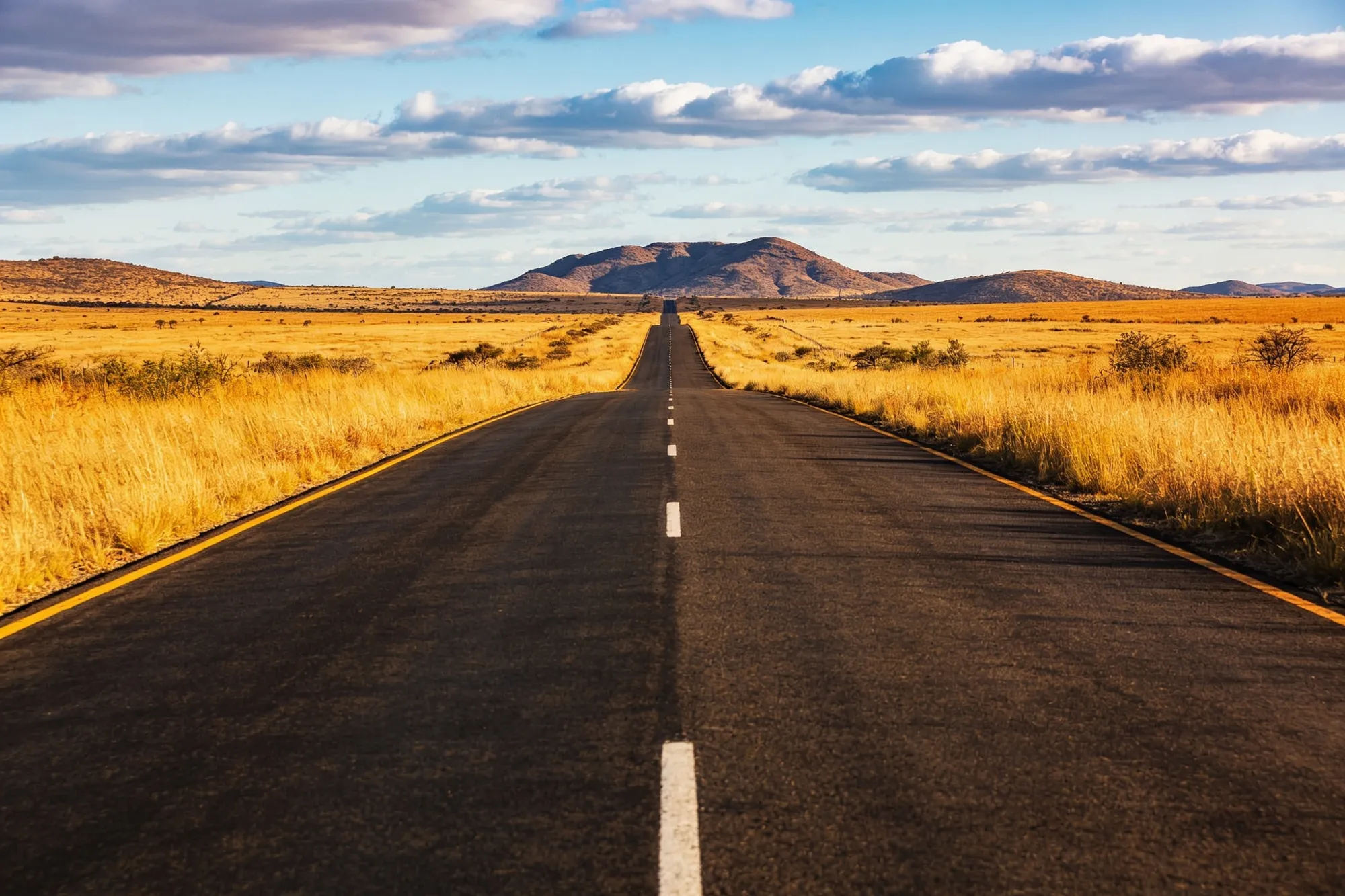
The national routes (the “N” roads, like the N1, N2 and N3) are excellent dual or single carriageways that link the major cities and most of the coast. Off them, the picture varies: secondary roads are usually fine, but you’ll also meet gravel and dirt roads in rural areas and near reserves, where you should slow right down, especially in a two-wheel-drive. Potholes appear even on good roads after heavy rain, and mountain passes ask for care and a cool head.
Distances are the thing most people underestimate. The country is large, the speed limits are real, and a route that looks short on the map can be a full day once you factor in towns, fuel stops and the odd gravel stretch. Plan modest daily drives and you’ll enjoy the road rather than endure it.
Tolls and fuel
Some national routes (parts of the N1, N3 and N4) have toll plazas where you pay by card or cash at a booth, from a few rand to a couple of hundred on the longer mainline routes. Keep a little cash for them just in case. The old Gauteng e-toll gantries around Johannesburg and Pretoria were switched off in 2024 and no longer charge anything, so you can ignore them.
Filling up is a pleasant surprise: South African fuel stations are full-service. An attendant pumps the fuel, will clean your windscreen and check your oil and tyres if you ask, and a small tip (around R5–R10) is the custom. Cards are accepted almost everywhere now, though it’s worth carrying some cash for remote stations. Fill up before long empty stretches and before entering a reserve, and make sure you put in the right fuel: most rentals are petrol, but confirm at pickup.
Local quirks worth knowing
A couple of habits will puzzle you the first time:
- The yellow line. On single-carriageway roads, slower vehicles often pull onto the paved hard shoulder to let you overtake, and you thank them with a quick flash of the hazard lights. It keeps the traffic flowing, but treat it with care: the shoulder can hide pedestrians, cyclists or a stopped car, so only use it when you can clearly see it’s clear.
- Minibus taxis are a huge part of local transport and can stop, pull off or change lane suddenly to pick up passengers. Give them room and expect the unexpected.
- Animals and people on the road. In rural areas, livestock, wildlife and pedestrians share the verges, particularly at dawn and dusk, which is the main reason to avoid driving at night out of town.
Staying safe
South Africa rewards a bit of street sense, and the advice is simple and effective:
- Don’t drive at night in rural areas. Unlit roads, pedestrians, livestock and the odd unmarked obstacle make it the single biggest avoidable risk. Aim to arrive before dark.
- At urban robots, keep doors locked, windows up and bags out of sight. Smash-and-grab thefts from cars stopped at lights do happen in the cities; a bag on the back seat is the usual target, so keep valuables in the boot or footwell.
- Stick to sensible routes. Trust a reputable GPS, but don’t blindly follow a shortcut through an area you don’t know. If a turn looks wrong, carry on to a busy, well-lit spot and rethink.
- If something goes wrong, prioritise your safety over the car. It’s insured; you’re not.
Keep the emergency numbers to hand: 112 from any mobile (it routes to a call centre), 10111 for the police, and 10177 for an ambulance. Private services like ER24 (084 124) and Netcare 911 (082 911) are widely used too.
Navigation
Google Maps works well in the cities and on the main routes, but mobile signal drops out in remote areas, so download the offline maps for your route before you set off. For the parks and back roads, Tracks4Africa is the local favourite and far more accurate off the tar. A phone mount and a charging cable (the full-service stations and your hire car both help here) round out the kit.
In the game reserves
Driving in a national park or reserve has its own rules, and they matter. Stay in your vehicle except at the marked rest camps and viewpoints, keep to the park speed limit (around 40 km/h, often less), and never drive off-road in a national park. Give animals right of way and plenty of space, switch the engine off and be patient at a sighting, and watch the gate times: parks close their gates at sunset and lock you out, or in, if you’re late, so plan your last drive to finish with time to spare.
The short version: drive on the left, carry your licence (plus an IDP if it isn't in English) and your passport, book an automatic ahead of time, and don't drive at night out of town. Keep doors locked at city robots, fill up before remote stretches and tip the fuel attendant, download offline maps, and respect park gate times. Do that, and a South African road trip is as easy and rewarding as they come.
Planning a self-drive?
Compare car hire and flights for your trip and lock in the best rates through our partner.